Crime Scene Documentation
Crime scene documentation begins with the first responder. Police officers are taught the importance of taking notes from the time of arrival. The crime scene investigator documents the scene in the form of still and video photography. Sketches are completed at the scene to illustrate relationships between articles of evidence not easily depicted by photography. The following methods of crime scene documentation are used to provide an accurate representation of the scene.
Note Taking
It is important that the responding officers note the condition of the scene as it existed upon their arrival. Note taking should be continuously updated during the course of the investigation.
Investigator's notes might include such factors as:
- Victim & Witness Statements.
- Who Was Present at The Scene.
- Lighting Conditions.
- Open Doors & Windows.
- Odors.
- Date & Time Indicators e.g. Newspapers, Mail.
- General Descriptions of The scene & Surrounding Area.
Photography and Videography
|
The primary means of crime scene documentation is still photography. Police officers should have an understanding of the importance of keeping the scene preserved, and not moving anything until it is photographed. The photographer must be able to testify that the photograph is a true and accurate representation of the scene at the time the photograph was taken. Crime scene photographs should reveal a detailed, chronological story of the scene. |
|
Sketching
Photographs may not always depict spatial relationships between objects; sketches are used to supplement photographs. Sketches can more easily depict the overall layout of the scene and the relationships between objects. Investigators usually complete hand-drawn, rough sketches while at the crime scene. These sketches contain all the necessary information for the investigator to subsequently complete a finalized version.
For courtroom presentation, hand drawn sketches may be converted using computerized programs such as computer aided design (CAD), which provide a dynamic, professional appearance.
Types of sketches may include:
- Entire Scene - Complete Scene With Measurements.
- Bird's-Eye View – Overhead View of The Scene.
- Elevation Sketch.
- Cross Projection Sketch.
- Three Dimensional Sketch.
(Information provided by the Department of Justice)
Essential Reading
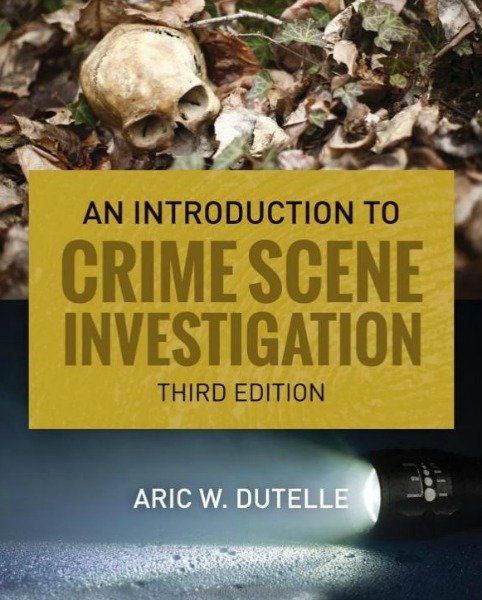
In a world heavily influenced by popular forensic television dramas, the real-life duties and complexities involved in crime-scene investigation are often misrepresented and misunderstood. An Introduction to Crime-Scene Investigation, Third Edition is a comprehensive and accurate overview of the practical application of forensic science in crime scene investigation. Focusing on the day-to-day aspects, this full-color text describes the methodologies and technologies employed by crime scene personnel, and pushes the reader to identify the interrelated components of the investigative process.
Recognizing the importance of those who have contributed to and advanced the field of forensic science, the reader is introduced to CSI through a historical perspective. The updated Third Edition covers components not typically found in many crime scene texts, including ethical considerations and public misconceptions of the investigative process—the so-called “CSI Effect.” Extensive discussion of physical evidence examination and analysis is provided, including the forensic potential of physical evidence, crime scene procedures, and what evidence should be documented, collected, and preserved. Real-life examples and over 250 detailed, full-color photos and figures enhance comprehension and demonstrate specific strategies for technique application
While the vast majority of the text is written with an American audience in mind, the author has chosen to call upon his significant international experience and include cases, information, and photographs/figures which are external to the United States.
An Introduction to Crime-Scene Investigation, Third Edition is an invaluable reference and essential educational resource.
See following link for full details.
Introduction to Crime Scene Investigation
Recent Articles


-
All About Forensic Science
Nov 12, 24 03:05 AM
A forensic science website designed to help anybody looking for detailed information and resources. -
The Role of Forensic Evidence in Criminal Defense Cases
Sep 05, 24 03:38 AM
 Article exploring five key roles that forensic evidence plays in criminal defense cases
 -
The Evolving Role of Medical Science in Forensic Investigations
Aug 06, 24 03:35 AM
 Insightful article exploring the critical role of medical science in forensic investigations.
Go To The Main Crime Scene Investigation Page
New! Comments
Have your say about what you just read! Leave me a comment in the box below.