Forensic DNA
Anybody looking for information about forensic DNA will come across a number of related terms e.g. genetic fingerprinting, DNA testing, DNA typing, DNA profiling etc. Generally speaking all of these terms refer to techniques and scientific procedures that can be employed to differentiate between individuals and as such, DNA in a legal context is synonymous with forensic identification.
Want To Study Forensics/CSI?

The forensic identification process typically involves forensic scientists scanning 13 DNA regions. Data extracted is then used to create an individual DNA profile (also known as a DNA fingerprint). DNA Uses for Forensic Identification include:
- Identifying potential suspects whose DNA may match evidence left at crime scenes.
- Exonerating persons wrongly accused of crimes.
- Identifying crime and catastrophe victims.
- Establishing paternity and other family relationships.
- Identifying endangered and protected species.
- Detecting bacteria and other organisms that may pollute air, water, soil, and food.
- Matching organ donors with recipients in transplant programs.
- Determining pedigree for seed or livestock breeds.
- Authenticating consumables such as caviar and wine.
(The Human Genome Project)
Fascinating TED talk by expert forensic scientist Rich Guerreri discussing the history of DNA testing in America and the promise new forensic DNA technology holds for identifying missing persons and exonerating wrongly incarcerated individuals.
Mitochondrial DNA (mtDNA)
Mitochondrial DNA (mtDNA) has provided forensic scientists with a valuable tool for determining the source of DNA recovered from damaged, degraded, or very small biological samples. MtDNA is a small circular genome located in the mitochondria, which are located outside of a cell's nucleus.
|
The Majority of human cells contain hundreds of copies of mtDNA genomes, as opposed to two copies of the DNA that is located in the nucleus. This high copy number increases the likelihood of recovering sufficient DNA from compromised DNA samples, and for this reason, mtDNA can play an important role in missing persons investigations, mass disasters, and other forensic investigations involving samples with limited biological material. |
|
In addition, mtDNA is maternally inherited. Therefore, barring a mutation, an individual's mother, siblings, as well as all other maternally-related family members will have identical mtDNA sequences. Consequently, forensic comparisons can be made using a reference sample from any maternal relative, even if the unknown and reference sample are separated by many generations.
Forensic DNA Analysis
DNA analysis is a powerful tool as each person’s DNA is unique (except in the case of of identical twins). Therefore, DNA evidence collected from a crime scene can implicate or eliminate a suspect. It also can analyze unidentified remains through comparisons with DNA from relatives. Also, when evidence from one crime scene is compared with evidence from another, those crime scenes can be linked to the same perpetrator locally, statewide, and nationally.
DNA is also a powerful tool because when biological evidence from crime scenes is collected and stored properly, forensically valuable DNA can be found on evidence that may be decades old. Therefore, old cases that were previously considered unsolvable may contain valuable DNA evidence capable of identifying the perpetrator.
DNA is often compared with fingerprints in the way matches are determined. When using either DNA or fingerprints to identify a suspect, the evidence collected from the crime scene is compared with a "known" standard. If identifying features are the same, the DNA or fingerprint can be determined to be a match. However, if identifying features of the DNA profile or fingerprint are different from the known standard, it can be determined that it did not come from that known individual.
Forensic DNA Testing
The evolution of DNA testing advanced significantly when Dr. Kary Mullis discovered that DNA could be copied in the laboratory much as it is in the natural world.
The copying process, known as polymerase chain reaction (PCR), uses an enzyme (polymerase) to replicate DNA regions in a test tube. By repeating the copying process, a small number of DNA molecules can be reliably increased up to billions within several hours.
Restriction Fragment Length Polymorphism (RFLP) analysis requires a biological sample about the size of a quarter, but PCR can be used to reproduce millions of copies of the DNA contained in just a few skin cells. Since PCR analysis requires only a minute quantity of DNA, it can enable the laboratory to analyze highly degraded evidence for DNA.
On the other hand, because the sensitive PCR technique replicates any and all of the DNA contained in an evidence sample, greater attention to contamination issues is required when identifying, collecting, and preserving DNA evidence. These factors may be particularly important in the evaluation of unsolved cases in which evidence might have been improperly collected or stored.
STR Analysis
Short Tandem Repeat (STR) technology is a forensic analysis that evaluates specific regions (loci) found on nuclear DNA. The variable (polymorphic) nature of the STR regions that are analyzed for forensic testing intensifies the discrimination between one DNA profile and another. For example, the likelihood that any two individuals (except identical twins) will have the same 13-loci DNA profile can be as high as 1 in 1 billion or greater.
The Federal Bureau of Investigation (FBI) has chosen 13 specific STR loci to serve as the standard for the Combined DNA Index System (CODIS). The purpose of establishing a core set of STR loci is to make sure that all forensic laboratories can establish uniform DNA databases and, more importantly, share valuable forensic information.
If the forensic or convicted offender CODIS index is to be used in the investigative stages of unsolved cases, DNA profiles must be generated by using STR technology and the specific 13 core STR loci selected by the FBI.
(Information provided by the Department of Justice)
Essential Reading
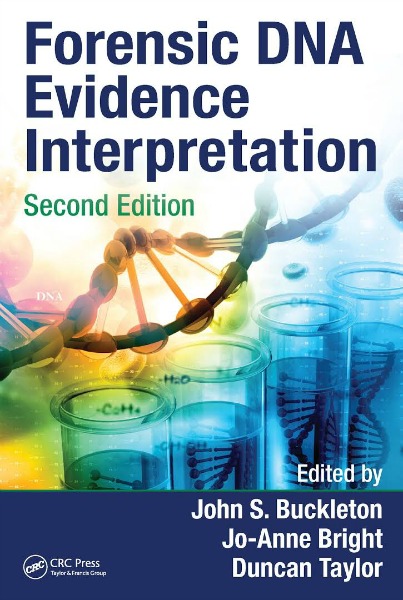
Now in its second edition, Forensic DNA Evidence Interpretation is the most comprehensive resource for DNA casework available today. Written by leaders in the fields of biology and statistics, including a contribution from Peter Gill, the father of DNA analysis, the book emphasizes the interpretation of test results and provides the necessary formulae in an easily accessible manner. This latest edition is fully updated and includes current and emerging techniques in this fast-moving field.
The book begins by reviewing all pertinent biology, and then provides information on every aspect of DNA analysis. This includes modern interpretation methods and contemporary population genetic models available for estimating DNA frequencies or likelihood ratios. Following a chapter on procedures for validating databases, the text presents overviews and performance assessments of both modern sampling uncertainty methods and current paternity testing techniques, including new guidelines on paternity testing in alignment with the International Society for Forensic Genetics. Later chapters discuss the latest methods for mixture analysis, LCN (ultra trace) analysis and non-autosomal (mito, X, and Y) DNA analysis. The text concludes with an overview of procedures for disaster victim identification and information on DNA intelligence databases.
Highlights of the second edition include:
- New information about PCR processes, heterozygote balance and back and forward stuttering.
- New information on the interpretation of low template DNA, drop models and continuous models.
- Additional coverage of lineage marker subpopulation effects, mixtures and combinations with autosomal markers.
This authoritative book provides a link among the biological, forensic, and interpretative domains of the DNA profiling field. It continues to serve as an invaluable resource that allows forensic scientists, technicians, molecular biologists and attorneys to use forensic DNA evidence to its greatest potential.
See following link for full details.
Forensic DNA Evidence Interpretation
Recent Articles


-
All About Forensic Science
Nov 12, 24 03:05 AM
A forensic science website designed to help anybody looking for detailed information and resources. -
The Role of Forensic Evidence in Criminal Defense Cases
Sep 05, 24 03:38 AM
 Article exploring five key roles that forensic evidence plays in criminal defense cases
 -
The Evolving Role of Medical Science in Forensic Investigations
Aug 06, 24 03:35 AM
 Insightful article exploring the critical role of medical science in forensic investigations.
New! Comments
Have your say about what you just read! Leave me a comment in the box below.