Forensic Accounting
Forensic accounting is the application of accounting principles, theories, and disciplines to facts or hypotheses at issue in a legal dispute, and encompasses every branch of accounting knowledge. (Technical Working Group on Education in Fraud and Forensic-Accounting.)
There are two major aspects within forensic accounting practice; litigation services that recognize the role of a Certified Public Accountant (CPA) as an expert or consultant and investigative services that make use of the CPA's skills, which may or may not lead to courtroom testimony.
Forensic accounting can involve the application of special skills in accounting, auditing, finance, quantitative methods, certain areas of the law and research, and investigative skills to collect, analyze, and evaluate evidential matter and to interpret and communicate findings.
Want To Study Forensics/CSI?

Fraud Related Definitions
Fraud (sometimes referred to as the fraudulent act) is "an intentional perversion of truth for the purpose of inducing another in reliance upon it to part with some valuable thing or to surrender a legal right; a false representation of a matter of fact." (Henry Campbell).
Fraud examination is a methodology for resolving fraud allegations from inception to disposition, including obtaining evidence, interviewing, writing reports and testifying.
|
Fraud investigation takes place when indicators of fraud, such as missing cash or other evidence, suggest that a fraudulent act has occurred and requires investigation to determine the extent of the losses and the identity of the perpetrator. |
|
Fraud prevention refers to creating and maintaining environments where the risk of a particular fraudulent activity is minimal and opportunity is eliminated.
Fraud deterrence refers to creating environments in which people are discouraged from committing fraud. Deterrence is usually accomplished through a variety of efforts associated with internal controls and ethics programs that create a workplace of integrity and encourage employees to report potential wrongdoing. Fraud deterrence can also be achieved through the use of continuous monitoring/auditing software tools.
Fraud remediation refers to the recovery of losses through insurance, the legal system or other means and the modification of operational processes and procedures, including changes to the system of internal control deemed necessary to minimize or deter a recurrence of similar fraud in the future.
Career Information
The following information provided courtesy of the United States Department of Labor relates to accountants and auditors in general but will also be of use to anyone considering a forensic accounting career.
Public Accountants & Forensic Accounting
Public accountants perform a broad range of accounting, auditing, tax, and consulting tasks. Their clients include corporations, governments, and individuals.
Public accountants work with financial documents that clients are required by law to disclose. These include tax forms and balance sheet statements that corporations must provide potential investors. For example, some public accountants concentrate on tax matters, advising corporations about the tax advantages of certain business decisions or preparing individual income tax returns.
Public accountants, many of whom are Certified Public Accountants (CPAs), generally have their own businesses or work for public accounting firms. Publicly traded companies are required to have CPAs sign documents they submit to the Securities and Exchange Commission (SEC), including annual and quarterly reports.
Some public accountants specialize in forensic accounting, investigating financial crimes such as securities fraud and embezzlement, bankruptcies and contract disputes, and other complex and possibly criminal financial transactions. Forensic accountants combine their knowledge of accounting and finance with law and investigative techniques to determine if an activity is illegal. Many forensic accountants work closely with law enforcement personnel and lawyers during investigations and often appear as expert witnesses during trials.
Work Environment
Accountants and auditors held about 1.3 million jobs in 2014. The industries that employed the most accountants and auditors were as follows:
- Accounting, tax preparation, bookkeeping, and payroll services 26%
- Government 8%
- Finance and insurance 8%
- Management of companies and enterprises 7%
- Manufacturing 6%
Most accountants and auditors work in offices, although some work from home. The work tends to be fast-paced and can be stressful. Although they complete much of their work alone, they sometimes work in teams with other accountants and auditors. Accountants and auditors may travel to their clients’ places of business.
Education & Training
Most accountant and auditor positions require at least a bachelor’s degree in accounting or a related field. Some employers prefer to hire applicants who have a master’s degree, either in accounting or in business administration with a concentration in accounting.
A few universities and colleges offer specialized programs, such as a bachelor’s degree in internal auditing. In some cases, those with associate’s degrees, as well as bookkeepers and accounting clerks who meet the education and experience requirements set by their employers, get junior accounting positions and advance to accountant positions by showing their accounting skills on the job.
Many colleges help students gain practical experience through summer or part-time internships with public accounting or business firms.
Licenses, Certifications, and Registrations
Every accountant filing a report with the Securities and Exchange Commission (SEC) is required by law to be a Certified Public Accountant (CPA). Many other accountants choose to become a CPA to enhance their job prospects or to gain clients. Many employers will often pay the costs associated with the CPA exam.
CPAs are licensed by their state’s Board of Accountancy. Becoming a CPA requires passing a national exam and meeting other state requirements. Almost all states require CPA candidates to complete 150 semester hours of college coursework to be certified, which is 30 hours more than the usual 4-year bachelor’s degree. Many schools offer a 5-year combined bachelor’s and master’s degree to meet the 150-hour requirement, but a master’s degree is not required.
A few states allow a number of years of public accounting experience to substitute for a college degree.
All states use the four-part Uniform CPA Examination from the American Institute of Certified Public Accountants (AICPA). Candidates do not have to pass all four parts at once, but most states require that they pass all four parts within 18 months of passing their first part.
Almost all states require CPAs to take continuing education to keep their license.
Certification provides an advantage in the job market because it shows professional competence in a specialized field of accounting and auditing. Accountants and auditors seek certifications from a variety of professional societies. Some of the most common certifications are listed below:
The Institute of Management Accountants offers the Certified Management Accountant (CMA) to applicants who complete a bachelor’s degree. Applicants must have worked at least 2 years in management accounting, pass a two-part exam, agree to meet continuing education requirements, and comply with standards of professional conduct. The exam covers areas such as financial statement analysis, working-capital policy, capital structure, valuation issues, and risk management.
The Institute of Internal Auditors (IIA) offers the Certified Internal Auditor (CIA) to graduates from accredited colleges and universities who have worked for 2 years as internal auditors and have passed a four-part exam. The IIA also offers the Certified in Control Self-Assessment (CCSA), Certified Government Auditing Professional (CGAP), Certified Financial Services Auditor (CFSA), and Certification in Risk Management Assurance (CRMA) to those who pass the exams and meet educational and experience requirements.
ISACA offers the Certified Information Systems Auditor (CISA) to candidates who pass an exam and have 5 years of experience auditing information systems. Information systems experience, financial or operational auditing experience, or related college credit hours can be substituted for up to 3 years of experience in information systems auditing, control, or security.
For accountants with a CPA, the AICPA offers the option to receive any or all of the Accredited in Business Valuation (ABV), Certified Information Technology Professional (CITP), or Personal Financial Specialist (PFS) certifications. The ABV requires a written exam, completion of at least six business valuation projects, and 75 hours of continuing education. The CITP requires 1,000 hours of business technology experience and 75 hours of continuing education. Candidates for the PFS also must complete a certain amount of work experience and continuing education, and pass a written exam.
Job Outlook & Prospects
Employment of accountants and auditors is projected to grow 11 percent from 2014 to 2024, faster than the average for all occupations. Globalization, a growing overall economy, and an increasingly complex tax and regulatory environment are expected to lead to strong demand for accountants and auditors.
In general, employment growth of accountants and auditors is expected to be closely tied to the health of the overall economy. As the economy grows, these workers will continue to be needed to prepare and examine financial records. In addition, as more companies go public, there will be greater need for public accountants to handle the legally required financial documentation.
Stricter laws and regulations, particularly in the financial sector, will likely increase the demand for accounting services as organizations seek to comply with new standards. In addition, tighter lending standards are expected to increase the importance of audits, as this is a key way for organizations to demonstrate their creditworthiness.
The continued globalization of business may lead to increased demand for accounting expertise and services related to international trade and international mergers and acquisitions.
Accountants and auditors who have earned professional recognition, especially as Certified Public Accountants (CPAs), should have the best prospects. Job applicants who have a master’s degree in accounting or a master’s degree in business with a concentration in accounting also may have an advantage.
Strong demand for accountants may lead to good prospects for entry-level positions. However, competition will be stronger for jobs with the most prestigious accounting and business firms.
Pay
The median annual wage for accountants and auditors was $67,190 in May 2015. The median wage is the wage at which half the workers in an occupation earned more than that amount and half earned less. The lowest 10 percent earned less than $41,400, and the highest 10 percent earned more than $118,930.
In May 2015, the median annual wages for accountants and auditors in the top industries in which they worked were as follows:
- Finance and insurance $71,760
- Management of companies and enterprises $69,560
- Manufacturing $68,020
- Accounting, tax preparation, bookkeeping, and payroll services $67,440
- Government $65,180
Most accountants and auditors work full time. In 2014, about 1 in 5 worked more than 40 hours per week. Longer hours are typical at certain times of the year, such as at the end of the budget year or during tax season.
Essential Reading
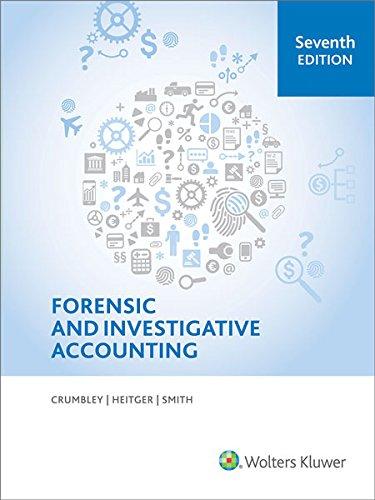
Forensic Accounting is a growing area of practice in which the knowledge, skills and abilities of advanced accounting are combined with investigative expertise and applied to legal problems. Forensic accountants are often asked to provide litigation support where they are called on to give expert testimony about financial data and accounting activities. In other more proactive engagements, they probe situations using special investigative accounting skills and techniques. Some even see forensic accounting as practiced by skilled accounting specialists becoming part and parcel of most financial audits - an extra quality control step in the auditing process that will help reduce financial statement fraud.
Forensic and Investigative Accounting (7th Edition) is a complete and readily teachable text on today's most timely accounting topics. Written by three top accounting and forensic teachers, this text covers all the important underpinnings, as well as the substance of forensic accounting. It covers both litigation support and investigative accounting, examining the practical aspects of these two areas, as well as many of the newer technological areas. Forensic and Investigative Accounting explains and demonstrates how an effective forensic accountant needs a solid understanding of accounting, investigative auditing techniques, criminology, and courtroom procedures, as well as excellent communications skills, both written and oral.
In today's litigious and highly regulated climate, all accountants - external, internal, forensic consultants, and corporate accountants - must possess this knowledge base and develop these techniques. This intriguing text provides unparalleled guidance to help develop the mindset and the skillset to meet the evolving challenges facing accountants today.
The 7th Edition includes new fraud schemes, numerous new eyewitness and spotlight stories, and new forensic techniques and tools, such as timeline analysis, link analysis, invigilation, genograms, proof of cash, entity charts, and full-and-false inclusion tests. This edition brings the reader up to date with the latest cybercrime activity and cases, and it documents the latest corruption schemes and explains how to find and prevent them.
See following link for full details.
Forensic and Investigative Accounting
Recent Articles


-
All About Forensic Science
Nov 12, 24 03:05 AM
A forensic science website designed to help anybody looking for detailed information and resources. -
The Role of Forensic Evidence in Criminal Defense Cases
Sep 05, 24 03:38 AM
 Article exploring five key roles that forensic evidence plays in criminal defense cases
 -
The Evolving Role of Medical Science in Forensic Investigations
Aug 06, 24 03:35 AM
 Insightful article exploring the critical role of medical science in forensic investigations.
New! Comments
Have your say about what you just read! Leave me a comment in the box below.