Forensic Psychology
I wrote the following article for my forensic psychology website, if you would like to learn more about this fascinating topic, make sure you visit the site where you will be able to access free and comprehensive information and resources. See following link.
Want To Study Forensic Psychology?

What is Forensic Psychology?
When my students arrived for their first lecture, I would always begin by giving them a few minutes to write down an answer to the question - what is forensic psychology? (Before reading on, why not jot down your answer).
|
I did this because despite the fact that nearly every undergraduate psychology student chose to do my forensic-psychology course, not one of them came to see me in advance to ask what is was about. |
|
Now bear in mind students chose their courses weeks before the start date, and to help them make an informed choice they were strongly advised to speak to the lecturer running the courses that they were interested in. So why the no show?
Having discussed it with the students, it turns out that most of them felt that they didn't need to ask what forensic psychology was all about, because they thought they already had a pretty clear idea.
Now, I mentioned I would give students a short time to write down an answer to the question what is forensic psychology but what I didn't mention, is that after a couple of minutes I would ask for their attention and apologize for forgetting to tell them that they weren't allowed to make any reference to serial killers, the film 'Silence of the lambs,' criminal profilers or the TV series 'Criminal Minds' in their answer.
It was usually as this point that most of the writing in the lecture theatre stopped. If you're thinking I would have stopped writing as well, please contain your disappointment and don't rush off just yet.
The answer to the question, what is forensic psychology may not quite be what you thought, but that doesn't mean that the subject has to be any less engaging.
A Divided Discipline
The first thing to note when addressing the question, what is forensic-psychology, is that even psychologists in the field are divided as to what the answer is.
Gudjonsson and Haward note that the division of criminological and legal psychology within the British Psychological Society argued for twenty years as to whether their members should be entitled to call themselves Chartered Forensic Psychologists.
The problem it seems is that people working (both directly and indirectly) in the field are drawn from a wide range of disciplines, so it has always been difficult to state what the boundaries are when addressing the question what is forensic-psychology.
- Psychologists in the prison/correctional services.
- Clinical psychologists in special hospitals & the psychiatric services.
- Educational psychologists.
- Occupational/Industrial psychologists.
- Academics.
Now while it is important to acknowledge that this fragmentation of role exists, it is just as important to realize that these different groups are linked to forensic-psychology because their work, expert knowledge or research activity is somehow connected with the law.
This legal connection makes perfect sense when you consider that the word forensic comes from the Latin forensis, which literally means appertaining to the forum, specifically the imperial court of Rome. So in essence:
The debate as to what is forensic-psychology and what is not forensic psychology rests primarily on the nature of psychology’s relationship with the legal system.
Let me give you an example. Imagine two psychologists meet at a conference and they begin talking about the work they do.
The first psychologist tells the second that she recently gave expert testimony in court arguing that the defendant in a murder case was criminally insane. The judge and jury agreed and having been found guilty on the grounds of diminished responsibility the defendant was going to be sent to a secure psychiatric unit.
Now there’s a coincidence the second psychologist says I work in the unit where they're sending him, so I’ll be dealing and treating this guy when he arrives.
So here you have a situation where 2 psychologists are linked to the legal system by way of a legal decision. You could argue, therefore, that both deserve to be seen as engaging in forensic-psychology. However, there’s a crucial difference.
The first psychologist actually helped inform the legal decision based on her psychological knowledge and expertise. The second psychologists involvement on the other hand arose as a consequence of a legal decision that she had no direct involvement with.
My preferred definition within the what is forensic-psychology debate acknowledges this key distinction, namely:
That branch of applied psychology which is concerned with the collection, examination and presentation of evidence for judicial purposes. (Haward 1981)
If you adopt this definition, the answer to the question what is forensic psychology becomes much more clear, because you are stating categorically that forensic-psychology relates to:
The provision of psychological information for the purpose of facilitating a legal decision. (Blackburn 1996)
So in the case of our two psychologists, strictly speaking only the first can be said to be engaged in Forensic- Psychology.
Now not everybody would agree with this, because there is a school of thought that that any activity which links psychology to the law deserves to be described as forensic. I’m not going to try and convince you which is right (not much anyway!) The main thing is that you know that this debate exists.
Summary
So in answering the question, what is forensic-psychology we have discovered that in essence:
- Forensic psychology refers to the application of psychology within a legal context.
- The debate as to what is and what is not forensic-psychology relates to the nature of this legal application and the level at which it is applied.
And that this debate raises a number of questions that you need to think about. In particular:
- The boundaries of forensic-psychology.
- The role of the forensic psychologist.
- The credibility of forensic-psychology.
Essential Reading
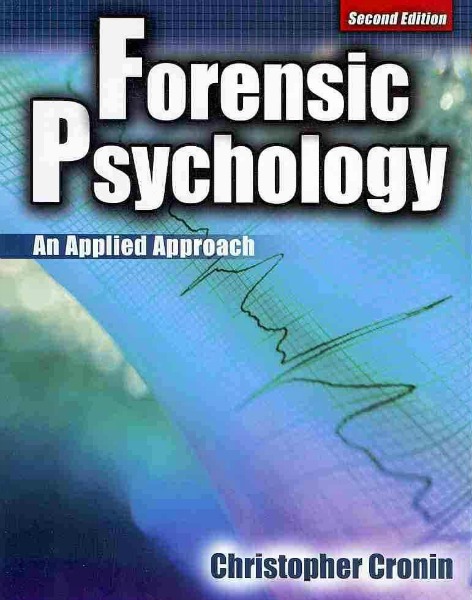
Written by a practicing forensic psychologist and university professor, Forensic-Psychology: An Applied Approach introduces the reader to the practice of forensic psychology and offers the reader a broad overview of the many opportunities available to forensic psychologists.
The first section of the book presents an overview of the forensic-psychology field. The remaining chapters present the work of forensic psychologists in specific areas: criminal responsibility and competency to stand trial evaluations, police psychology, correctional psychology, child custody evaluations, and personal injury evaluations as well as exploring emerging trends in the field.
The text also presents information from the field of legal psychology including trial consultation, eyewitness testimony and investigative psychology (profiling, hypnosis, detection of deception and psychological autopsies).
See following link for full details.
Recent Articles


-
All About Forensic Science
Nov 12, 24 03:05 AM
A forensic science website designed to help anybody looking for detailed information and resources. -
The Role of Forensic Evidence in Criminal Defense Cases
Sep 05, 24 03:38 AM
 Article exploring five key roles that forensic evidence plays in criminal defense cases
 -
The Evolving Role of Medical Science in Forensic Investigations
Aug 06, 24 03:35 AM
 Insightful article exploring the critical role of medical science in forensic investigations.
New! Comments
Have your say about what you just read! Leave me a comment in the box below.