Forensic Engineering
by Dr Peter R Lewis
(Oxford England)
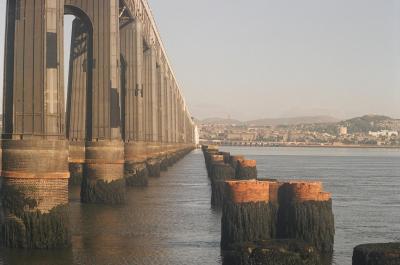
Tay rail bridge, Dundee Scotland with stumps of old bridge at right
I teach and consult as a forensic engineer, so I thought I would share my enthusiasm for the subject with you.
We have many methods in common with forensic scientists, such as microscopy and chemical analysis as well as being able to comment on witness statements and appearing in court to present our evidence.
So what do we do? We investigate accidents where product failure has caused personal injury (such as a car accident), or where there is a design flaw in a product so all have to be recalled. We often use trace evidence to show how a component failed, or to verify the truth of a witness statement just like the forensic scientist uses trace evidence like DNA or fingerprints to establish who was at a crime scene. And some times we get involved in major disasters, where a bridge suddenly collapses or a train derails killing many people. And this leads naturally to cold case research, where we re-analyse an old disaster to show what really happened. We have re-analysed the Tay Bridge disaster from 1879 for example, and you will find full details at our website:
http://www.open2.net/forensicengineering/modern_methods.html
By examining the superb photographs which were taken at the time, we were able to show that the design of the bridge was totally flawed from the very beginning. But many people still believe that the bridge was blown down by a storm on the night of the disaster, which we think is a very misleading idea.
We have also recently written a book on our work (Forensic Materials Engineering: Case Studies by Lewis, Reynolds and Gagg CRC Press, 2004) which you can consult to see what range of research we perform.
Comments for Forensic Engineering
|
||
|
||
|
||
